A smartwatch is a wearable computer in the form of a watch; modern smartwatches provide a local touchscreen interface for daily use, while an associated smartphone app provides for management and telemetry (such as long-term biomonitoring). While early models could perform basic tasks, such as calculations, digital time telling, translation, and game-playing, 2010s smartwatches have more general functionality closer to smartphones, including mobile phones, a mobile operating system and WiFi/Bluetooth connectivity. Some smartwatches function as portable media players, with FM radio and playback of digital audio and video files via a Bluetooth headset. Some models, called watch phones (or vice versa), have mobile cellular functionality like making calls
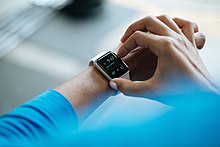
A person wearing a contemporary smartwatch (Apple Watch)
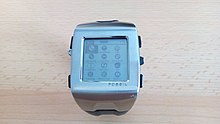
A smartwatch from the early-2000s (Fossil wrist PDA)
While internal hardware varies, most have an electronic visual display, either backlit LCD or OLED. Some use transflective or electronic paper, to consume less power. They are generally powered by a rechargeable lithium- ion battery. Peripheral devices may include digital cameras, thermometers, accelerometer, pedometers, heart rate monitors, altimeters, barometers, compasses, GPS receivers, tiny speakers, and micro SD cards, which are recognized as storage devices by many other kinds of computers.
Software may include digital maps, schedulers and personal organizer, calculators, and various kinds of watch faces. The watch may communicate with external devices such as sensors, wireless headsets, or a heads-up library. Like other computers, a smartwatch may collect information from internal or external sensors and it may control, or retrieve data from, other instruments or computers. It may support wireless technologies such as Bluetooth, Wi-Fi, and GPS. For many purposes, a “watch computer” serves as a front end for a remote system such as a smartphone, communicating with the smartphone using various wireless technologies. Smartwatches are advancing, especially their design, battery capacity, and health-related applications. Health-related applications include applications measuring heart rate, SpO2, workout etc.
Market and popularity :
Smartwatches have risen in popularity during the 2010s. They are often used as fitness trackers but also as smartphone entertainment or communication “companions”. Global smartwatch shipments counted 14 million in the third quarter of 2019.As of 2019 the market leader was apple,followed by samsung, Imoo, fitbit, amazefit, huawei, fossil and garmin
Smartwatch for childrens and elderly !
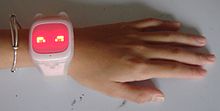
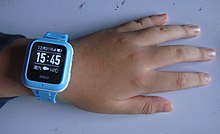
In China, since around 2015, smartwatches have become widely used by schoolchildren. They are advertised on television throughout China as a safety device whereby the child can call in Case of emergency. The devices are commonly colorful and made of plastic. They normally have no display unless a button is pushed. These smartwatches have limited capability compared to other smartwatches; their main functions consist of being able to conduct calls, displaying of time, and sometimes have air temperature sensitivity. They cost around $100 to US$200.
They are also offered in the US by companies such as Timex for T mobile and Gizmo watch for Verizon.
Some smart watches can also help elderly with dementia by reporting their location to a caretaker in case they get lost, or if they fall.
Advantages/Benefits of Smartwatch.
- Quick access to notifications. …
- Never miss your calls. …
- Personalized information and health tracking. …
- Make calls and send messages. …
- Watch movies and listen to music. …
- New watch faces every day. …
- Navigation. …
- Limited battery life.
Disadvantages/Drawbacks of Smartwatch.
➨Smart watches are pretty costly.
➨Some of the watches are not water resistant.
➨Touch screen is smaller compare to phone.
➨Battery life is short which is a concern.

 Site Title